the power of psalms pdf

The Power of Psalms: A Comprehensive Guide
Exploring the profound impact of Psalms, numerous resources offer access to this spiritual text in PDF format. Core.ac.uk provides a downloadable PDF
analyzing the healing power within scripture, detailing 66 Psalms for various needs.
These digital collections, like those referenced from FHE MSLU (2018), present Psalms as a form of spiritual medicine, emphasizing reverence for divine words.
What are Psalms?
Psalms represent a collection of 150 sacred poems, hymns, and prayers, forming a central component of the Old Testament and the Jewish Tanakh. They are deeply rooted in ancient Israelite worship and personal devotion, expressing a wide spectrum of human emotions – from profound joy and gratitude to lament, despair, and repentance.
Historically, these texts weren’t simply literary works; they were integral to liturgical practice, sung and recited in the Temple in Jerusalem. The very structure of the Psalms lends itself to musicality, contributing to their enduring power.

Contemporary interest in the “power of Psalms” often centers on their perceived therapeutic and spiritual benefits, readily accessible through numerous PDF resources available online. Documents, such as those found on core.ac.uk, highlight how these ancient verses are viewed as a form of “medicine” for the soul.
These PDFs often categorize Psalms based on their intended use – offering guidance for healing, protection, safe travel, and reconciliation. The belief that reverence for the words unlocks their healing potential is a recurring theme, emphasizing a mindful approach to reading and contemplation. The enduring appeal of the Psalms lies in their ability to articulate universal human experiences and offer solace, hope, and connection to the divine.
Historical and Religious Context of the Psalms
The Psalms emerged from the religious life of ancient Israel, spanning several centuries – from the time of David (around 1000 BCE) to the post-exilic period (after 539 BCE). Attributions to authors like David, Asaph, and the sons of Korah suggest a communal authorship and evolution over time. Their original context was deeply embedded in Temple worship, accompanying sacrifices and festivals.

The religious significance extends beyond Judaism, profoundly influencing early Christianity. The New Testament frequently quotes and alludes to the Psalms, interpreting them in light of Jesus Christ. This cross-cultural resonance contributes to the enduring appeal of the Psalms across diverse faith traditions.
The modern fascination with the “power of Psalms,” often explored in PDF documents, builds upon this historical foundation. Resources like those detailed on core.ac.uk demonstrate a continued belief in their spiritual efficacy.
These PDFs often present Psalms not merely as historical artifacts, but as living texts capable of providing guidance and healing. The historical understanding of their liturgical origins informs the contemporary practice of using them for personal devotion and spiritual well-being, bridging ancient tradition with modern needs.
The Psalms as Spiritual Medicine: Healing and Reverence
The concept of scripture as “medicine” is central to understanding the Psalms’ power, a notion explored extensively in available PDF resources. Documents, such as the one highlighted by FHE MSLU (2018) on core.ac.uk, explicitly state that God’s Word acts as a curative force. However, this healing isn’t automatic; it’s contingent upon a deep reverence for the divine text.
This reverence isn’t simply intellectual assent, but a heartfelt acknowledgement of the Psalms’ sacred origin and inherent power. The PDF materials suggest that approaching the Psalms with humility and faith unlocks their therapeutic potential. This aligns with ancient beliefs about the power of prayer and sacred utterance.
The 66 Psalms categorized for specific needs – safe travel, protection, healing, reconciliation – within these PDFs, demonstrate a practical application of this belief.
They aren’t viewed as mere poetic expressions, but as conduits for divine intervention. The act of reciting or meditating on these Psalms, with a reverent spirit, is believed to activate their healing properties, offering solace and strength to those in need.
Psalms for Specific Needs: A Categorized Overview
PDF resources detailing “The Power of Psalms” consistently present a categorized approach to their application, recognizing that different verses resonate with distinct life challenges. The document available on core.ac.uk, authored by FHE MSLU (2018), exemplifies this, listing 66 Psalms alongside their traditionally associated uses.
For protection, certain Psalms are recommended against enemies and adversity. Healing illnesses is addressed by specific verses believed to invoke divine wellness. Safe travel finds its support in Psalms offering guidance and guardianship on journeys.
Reconciling relationships benefits from Psalms focused on forgiveness, peace, and restoration. This categorization isn’t rigid, but provides a starting point for individuals seeking spiritual support.
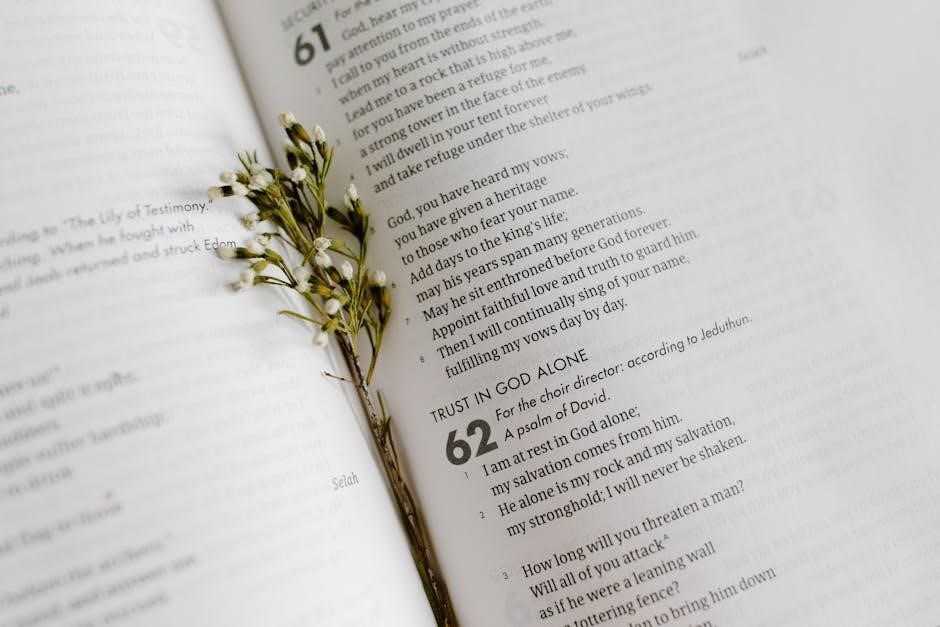
These PDFs often present this information in a practical format, allowing users to quickly identify Psalms relevant to their immediate needs. The categorization reflects a long-standing tradition of associating specific Psalms with particular intentions, offering a structured pathway to accessing their perceived power.
Psalms for Protection
PDF guides focusing on “The Power of Psalms” frequently highlight specific verses for safeguarding against harm, both physical and spiritual. Resources like the one detailed on core.ac.uk, from FHE MSLU (2018), explicitly include Psalms for “protection against enemies” within their categorized overview.
While the exact Psalms recommended vary between sources, certain themes consistently emerge. Verses invoking God’s strength, shield, and refuge are prominent. These Psalms often portray God as a warrior defending the faithful from adversity.
The perceived protective power isn’t merely passive; it’s often linked to a proactive declaration of faith and trust in divine intervention. Users of these PDFs are encouraged to engage with the text reverently, believing in its capacity to ward off negative influences.
Historically, this belief aligns with practices of “cunning folk” who utilized Psalms alongside herbal remedies for protective magic, as noted by A.V. Kosykh. The PDF resources present a more spiritually focused approach, emphasizing faith over ritual, yet the underlying desire for divine protection remains central.
Psalms for Healing Illnesses
Numerous “Power of Psalms” PDF resources emphasize the restorative potential of these ancient texts, positioning them as spiritual medicine. The core.ac.uk document (FHE MSLU, 2018) specifically lists Psalms designated for “healing illnesses,” reflecting a long-held belief in their therapeutic value.
These PDFs don’t typically advocate replacing conventional medical treatment, but rather supplementing it with faith-based practices. The underlying principle is that God’s word possesses inherent healing power, activated through reverence and sincere belief.
The selection of Psalms for healing often centers on verses that express trust in God’s mercy, plead for restoration, and celebrate divine deliverance from suffering. These Psalms frequently depict God as a compassionate healer, capable of alleviating physical and emotional distress.

The concept of scripture as healing aligns with broader traditions, including those explored in studies of Doukhobor cultic singing, where Psalms were integral to spiritual practices. While the context differs, the core belief in the Psalms’ ability to promote well-being remains consistent across these resources.
Psalms for Safe Travel
Several “Power of Psalms” PDF compilations dedicate sections to ensuring secure journeys, recognizing the anxieties associated with travel. The document available via core.ac.uk (FHE MSLU, 2018) explicitly lists Psalms traditionally used for “safe travel,” demonstrating a historical and continuing practice.
These Psalms often invoke God’s protection against dangers encountered on the road – bandits, accidents, harsh weather, and unforeseen obstacles. They express a reliance on divine guidance and guardianship, seeking a safe passage and a timely arrival.
The selection typically includes Psalms that emphasize God’s unwavering faithfulness and power to deliver from harm. Verses portraying God as a shield and refuge are particularly prominent, offering comfort and reassurance to travelers.
The practice of utilizing Psalms for protection extends beyond mere physical safety; it encompasses a spiritual safeguarding as well. This aligns with broader beliefs regarding the Psalms’ ability to ward off negative influences, a concept explored in studies of “cunning folk” and their use of scripture in healing magic.
Psalms for Reconciling Relationships
PDF resources detailing “The Power of Psalms” frequently categorize selections specifically for mending fractured relationships, acknowledging the pain and complexity of interpersonal conflict. The core.ac.uk document (FHE MSLU, 2018) directly identifies Psalms applicable to “reconciling relationships,” highlighting a long-held belief in their restorative power.
These Psalms often focus on themes of forgiveness, repentance, and the restoration of harmony. They implore divine intervention to soften hearts, promote understanding, and bridge divides between individuals. Prayers for empathy and compassion are central to this application.
The chosen verses typically emphasize humility and the acknowledgement of wrongdoing, encouraging a spirit of contrition and a willingness to seek amends. Psalms expressing a desire for peace and unity are also commonly included.
Beyond direct requests for reconciliation, these Psalms can foster inner peace and emotional resilience, enabling individuals to approach difficult conversations with grace and a constructive mindset. This aligns with the broader understanding of scripture as “medicine for healing,” as described in the referenced PDF.
The Role of Psalms in Russian Spiritual Tradition
Within the Russian spiritual tradition, the Psalms hold a uniquely prominent position, deeply interwoven with liturgical practices and choral music. Research, such as that by E. Podgaits (2020), traces a synthesis between Russian choral spiritual concerts and Jewish cult music, demonstrating the Psalms’ foundational role. Access to these traditions is often facilitated through PDF resources detailing “The Power of Psalms.”
Historically, Psalms were not merely recited but sung, forming the core of elaborate choral arrangements. These concerts weren’t simply performances; they were acts of worship, intended to elevate the spirit and foster a connection with the divine.
The tradition extends beyond formal church settings. Cultic singing amongst groups like the Doukhobors, as noted by A.V. Kosykh, incorporated texts from Russian spiritual verses – often rooted in the Psalms – into their devotional practices.
PDF documents exploring the Psalms often acknowledge this rich Russian heritage, highlighting the enduring power of these ancient texts to inspire musical creativity and spiritual devotion. They represent a living tradition, continuously reinterpreted and revitalized.

Psalms and Russian Choral Spiritual Concerts
Russian choral spiritual concerts represent a magnificent expression of faith, deeply rooted in the Psalms. As highlighted by E. Podgaits (2020), these concerts demonstrate a compelling synthesis of Russian musical traditions and Jewish cult music, with the Psalms serving as a central textual source. Many resources detailing “The Power of Psalms” in PDF format acknowledge this historical connection.
These weren’t simply musical events; they were elaborate liturgical performances designed to evoke profound spiritual experiences. The complex harmonies and soaring melodies were intended to elevate the listener, fostering a sense of reverence and connection with the divine.
PDF collections often feature scores and analyses of these choral works, revealing how composers interpreted and expanded upon the Psalms’ poetic and theological themes. The accessibility of these resources allows for a deeper understanding of the musical and spiritual significance of these concerts.
The enduring popularity of these concerts speaks to the Psalms’ continued relevance within Russian culture, demonstrating their power to inspire artistic expression and devotional practice. They remain a vibrant testament to a centuries-old tradition.
Psalms in the Practices of “Cunning Folk” and Healing Magic
Historically, “cunning folk” – practitioners of folk magic – incorporated passages from the Book of Psalms into their healing rituals. As documented by A.V. Kosykh, these individuals utilized Psalms alongside herbal remedies, believing in their potent spiritual power. Resources detailing “The Power of Psalms” in PDF format often touch upon this fascinating, yet often overlooked, aspect of the Psalms’ history.

The selection of specific Psalms wasn’t arbitrary; each was believed to possess unique properties suited to particular ailments or challenges. These weren’t viewed as solely religious texts, but as vessels of divine energy capable of influencing the physical world.
PDF documents exploring traditional healing practices frequently include examples of Psalm-based incantations and rituals. While modern perspectives may differ, understanding this historical context provides insight into the enduring belief in the Psalms’ transformative capabilities.
It’s crucial to approach this topic with sensitivity, recognizing the complex interplay between faith, folklore, and healing traditions. The use of Psalms in this context highlights their perceived power beyond purely devotional settings.
Psalms and Doukhobor Cultic Singing
Doukhobor spiritual practice heavily features the recitation and singing of Psalms, particularly within the context of Russian spiritual verses. A.V. Kosykh’s research highlights that these Psalms weren’t merely sung, but deeply integrated into their cultic performances, forming a core element of their worship. While direct access to comprehensive PDF resources detailing specifically Doukhobor Psalm usage is limited in the provided context, the significance is clearly established.
These performances involved extended, communal singing of Psalm texts, often without instrumental accompaniment, emphasizing the power of the word itself. The texts were often in Russian, reflecting a unique synthesis of Jewish cult music and Russian choral traditions, as noted by E. Podgaits.
The act of singing Psalms was considered a form of spiritual communion and a pathway to divine grace. Though a dedicated “Power of Psalms” PDF focusing solely on Doukhobor practice isn’t explicitly mentioned, understanding their tradition enriches the broader appreciation of the Psalms’ influence.
Further research into Doukhobor history and hymnology would reveal the specific Psalms favored and the nuances of their performance within their unique spiritual framework.
Analyzing Psalm Texts: A Linguistic and Historical Approach
A rigorous examination of Psalm texts requires both linguistic and historical methodologies. While the provided resources don’t detail a specific PDF dedicated to this analytical approach, they hint at the complexities involved. The Fayyumic Text of Psalm 118, discovered in Egypt (Bulletin de la Société…), demonstrates the early transmission and adaptation of these texts, necessitating paleographic and textual criticism.

Analyzing translations – such as those into Russian and Spanish (FHE MSLU, 2018) – reveals how cultural and theological perspectives shape interpretation. Linguistic analysis focuses on Hebrew poetic devices, rhetorical structures, and the evolution of vocabulary. Historical context illuminates the original intent and the socio-political environment influencing the Psalm’s composition.
Understanding the nuances of language and history is crucial for unlocking the full power of the Psalms. A comprehensive PDF resource would ideally combine these disciplines, offering detailed commentaries and comparative analyses of different versions.
The study of these texts, therefore, isn’t merely devotional; it’s a scholarly pursuit demanding meticulous attention to detail and a broad understanding of ancient Near Eastern cultures.
Fayyumic Texts of Psalms: Archaeological Discoveries
The discovery of Fayyumic Psalm texts represents a significant archaeological find, offering invaluable insights into the early reception and transmission of these sacred poems. Specifically, the “Fayyumic Text of Psalm 118, 5052, 6267, 7477” (Bulletin de la Société…) unearthed from the Pushkin Museum of Fine Arts (MS.I.1.b.637) provides tangible evidence of their presence in Egypt during late antiquity.
These texts, often written on papyrus, reveal how Psalms were utilized within early Christian communities. While a dedicated PDF cataloging all Fayyumic Psalm fragments may not be readily available, the existence of this particular manuscript demonstrates a widespread practice of copying and preserving these texts.
The archaeological context is crucial; it helps determine the text’s function – liturgical use, personal devotion, or magical practice. Further research into similar discoveries could potentially reveal a network of Psalm dissemination throughout the Roman Empire.
Although the provided resources don’t directly link to a comprehensive PDF, they highlight the importance of archaeological evidence in understanding the historical power and enduring appeal of the Psalms.
The Use of Psalms in Translation (Russian & Spanish)
The translation of Psalms into Russian and Spanish reveals fascinating insights into how cultural and linguistic nuances shape the reception of these texts. FHE MSLU’s 2018 research (core.ac.uk/download/pdf/78545842.pdf) specifically examines spiritual symbols within these translations, demonstrating how meaning is conveyed – and potentially altered – across languages.
Accessing Psalms in both languages, often through PDF formats, allows for comparative analysis of poetic devices and theological interpretations. The availability of these translated PDFs is crucial for scholars and practitioners seeking a deeper understanding of the Psalms’ universal appeal.
The act of translation itself is a powerful interpretive process, influencing how readers connect with the Psalms’ spiritual message. Differences in phrasing and emphasis can highlight varying cultural perspectives on themes like healing, protection, and reconciliation.
While a single PDF encompassing all Russian and Spanish translations may not exist, numerous online resources offer access to individual versions, facilitating comparative study and appreciation of the Psalms’ enduring power.
Finding Psalms in PDF Format: Resources and Accessibility
Locating Psalms in PDF format is increasingly accessible, with numerous online platforms offering digital copies of various translations and commentaries. Core.ac.uk, for instance, hosts a downloadable PDF (78545842.pdf) detailing the Psalms’ uses for healing, safe travel, and relational restoration, showcasing their practical application.
However, navigating the digital landscape requires discernment. While legitimate sources provide valuable resources, unverified downloads pose potential risks (discussed later). Academic databases, religious institutions’ websites, and established publishers are generally reliable starting points.
The proliferation of PDFs allows for convenient study and personal devotion. Users can easily search, annotate, and share these texts, fostering a wider engagement with the Psalms’ spiritual wisdom. Many PDFs also include accompanying musical scores or liturgical guides.
Accessibility varies depending on language and specific translation. Searching using keywords like “Psalms PDF,” “Russian Psalms PDF,” or “Spanish Psalms PDF” can yield relevant results, but careful evaluation of source credibility is paramount.
Legitimate Sources for “The Power of Psalms” PDF Downloads
Identifying trustworthy sources for “The Power of Psalms” PDFs is crucial. Academic repositories like Core.ac.uk offer scholarly analyses, such as the FHE MSLU (2018) publication exploring spiritual symbols in Bible translations, providing a solid foundation for study.
University libraries and theological seminaries often digitize and provide access to classic commentaries and translations of the Psalms through their online catalogs. Project Gutenberg, while not exclusively focused on religious texts, may contain public domain versions.
Reputable religious publishers, such as those specializing in Orthodox Christian or Catholic literature, frequently offer downloadable PDFs of study guides or devotional materials related to the Psalms. Always verify the publisher’s credentials.
Beware of websites promising free downloads without clear attribution or copyright information. Prioritize sources with established reputations and transparent publishing practices to ensure the authenticity and integrity of the content.
Checking for ISBNs or publisher details can help validate the legitimacy of a PDF before downloading.
Potential Risks Associated with Unverified PDF Downloads
Downloading “The Power of Psalms” PDFs from unverified sources carries significant risks. These files can harbor malware, viruses, or spyware, compromising your device’s security and potentially stealing personal information. Phishing attempts disguised as religious texts are also a concern.
Copyright infringement is a major issue; downloading unauthorized copies of copyrighted material is illegal and unethical. Such PDFs may contain inaccurate or altered translations, misrepresenting the original meaning of the Psalms and leading to misinterpretations.
The content itself could be misleading or harmful. Unscrupulous individuals might distribute PDFs promoting false doctrines or manipulative practices under the guise of spiritual guidance. Always critically evaluate the source and content.
Poorly formatted or corrupted PDFs can be difficult to read and may damage your device’s software. Prioritize downloads from reputable sources with robust security measures and clear copyright statements.
Protect yourself by using antivirus software, exercising caution when clicking links, and verifying the legitimacy of any PDF before opening it.
Understanding the Ethical Considerations of Using Psalms for Healing
Employing Psalms for healing necessitates a nuanced ethical approach. While the text, as explored in resources like those from FHE MSLU (2018), suggests scripture acts as “medicine,” it’s crucial to avoid replacing conventional medical treatment with solely spiritual practices.
Respecting individual autonomy is paramount. Imposing Psalm-based healing on someone without their informed consent is unethical. The belief in, and willingness to engage with, this practice must be freely given.
Avoiding exploitation is vital. Individuals seeking healing are often vulnerable; offering Psalms should be done with genuine compassion, not for personal gain or control.
Recognizing limitations is essential. Psalms may offer comfort and spiritual strength, but they aren’t a guaranteed cure for all ailments. Honest communication about expectations is key.
Maintaining humility and acknowledging the divine will are crucial. Healing is ultimately a matter of faith and trust, not a formula to be manipulated.



Leave a Reply
You must be logged in to post a comment.